
The orifice meter has been the workhorse of industrial flow measurement for over a century. Despite the development of numerous alternative technologies, including ultrasonic meters, Coriolis meters, vortex meters, and magnetic flowmeters, the orifice plate remains the most widely specified differential pressure flow device in process industry applications worldwide. Understanding when it is the genuinely correct choice and when an alternative should be considered requires a clear assessment of its strengths, limitations, and the conditions under which it delivers the best performance.
How the Orifice Flow Meter Works
An orifice flow meter consists of a precisely machined plate with a central circular orifice, installed between two pipe flanges. As the process fluid passes through the restriction, its velocity increases and its static pressure drops. The pressure difference between the upstream and downstream tapping points is measured using a differential pressure transmitter, and the flow rate is calculated from this measurement using the fundamental orifice flow equation.
The simplicity of this operating principle is one of the orifice meter’s greatest strengths; there is no technology within the meter itself beyond the machined plate, making it highly reliable and requiring minimal maintenance.
When the Orifice Flow Meter Is the Right Specification
Clean, Single-Phase Fluid Applications
The orifice meter performs best with clean, single-phase fluids, either liquids or gases, but not mixtures. Entrained solids erode the sharp upstream edge of the orifice, degrading measurement accuracy over time. Two-phase flow, liquid with entrained gas or gas with liquid droplets, produces erratic differential pressure readings that cannot be reliably converted to flow rate.
For clean water, refined hydrocarbon liquids, natural gas, steam, and air, the orifice meter delivers accurate and consistent measurements that are difficult to improve upon at comparable cost.
Budget-Constrained Applications Requiring Accuracy
The orifice plate itself is relatively inexpensive, and the differential pressure transmitters used to measure the pressure drop are standard industrial instruments available from multiple manufacturers. For applications where the capital cost of more sophisticated meters cannot be justified, the Orifice Meter provides a good balance of cost and accuracy.
| Flow Meter Type | Relative Capital Cost | Accuracy | Moving Parts |
| Orifice flow meter | Low | ±0.5–1.5% | None |
| Vortex meter | Moderate | ±0.5–1% | None |
| Ultrasonic (clamp-on) | Moderate to high | ±1–2% | None |
| Coriolis meter | High | ±0.1–0.3% | None |
| Magnetic flowmeter | Moderate | ±0.3–0.5% | None |
Well-Established Pipe Conditions
The orifice meter requires a known, consistent velocity profile in the upstream piping to deliver accurate measurement. Adequate straight pipe runs upstream and downstream of the meter, conforming to ISO 5167 requirements, are needed to ensure that the flow profile at the orifice is the fully developed profile that the meter equation assumes.
In established, well-designed piping systems where these straight run requirements can be met, the orifice meter is an excellent, proven choice.
When an Oil and Gas Separator is More Relevant Than Flow Measurement at the Meter
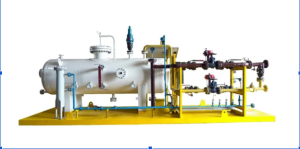
In upstream oil and gas applications, raw production fluids from a well are typically three-phase mixtures of oil, water, and gas. These mixtures cannot be accurately measured by any differential pressure flow device, including the orifice meter, until they have been separated. The oil and gas separator performs this separation, and individual flow meters, often orifice meters, are installed on each single-phase outlet stream.
This illustrates an important principle: the orifice meter is a highly capable device when applied correctly, but correct application means clean, single-phase flow conditions that are often only achieved downstream of separation or treatment equipment.
The Maintenance Advantages of the Orifice Meter
For applications in remote or difficult-to-access locations, the orifice meter’s minimal maintenance requirement is a significant advantage:
- The orifice plate can be inspected and replaced with the line taken out of service, using standard flanged connections
- No calibration is required in the field; recalculation of the meter constant after plate replacement uses standard equations
- The differential pressure transmitter is the only component requiring regular calibration, and this can be done remotely or with the process running using electronic calibrators
When to Specify an Alternative to the Orifice Meter
The Orifice Meter is not the right choice when:
- The fluid contains entrained solids that will erode the orifice edge
- High measurement accuracy is required over a wide flow turndown (the orifice meter’s typical 3:1 turndown is limiting)
- The permanent pressure loss cannot be accommodated in the system hydraulic balance
- The fluid is very low-density gas where the differential pressure generated is too small to measure accurately
Conclusion
The orifice meter remains the right choice for a very large proportion of industrial flow measurement applications, where the fluid is clean and single-phase, and the application does not demand the accuracy or turndown that only more sophisticated technologies can provide. Its combination of proven reliability, low maintenance, and reasonable cost makes it a sensible default specification for many duties. NND Oil & Gas supplies Orifice Meters and a comprehensive range of flow measurement equipment for oil and gas and process industry applications, providing engineering guidance to ensure correct specifications for every application.